
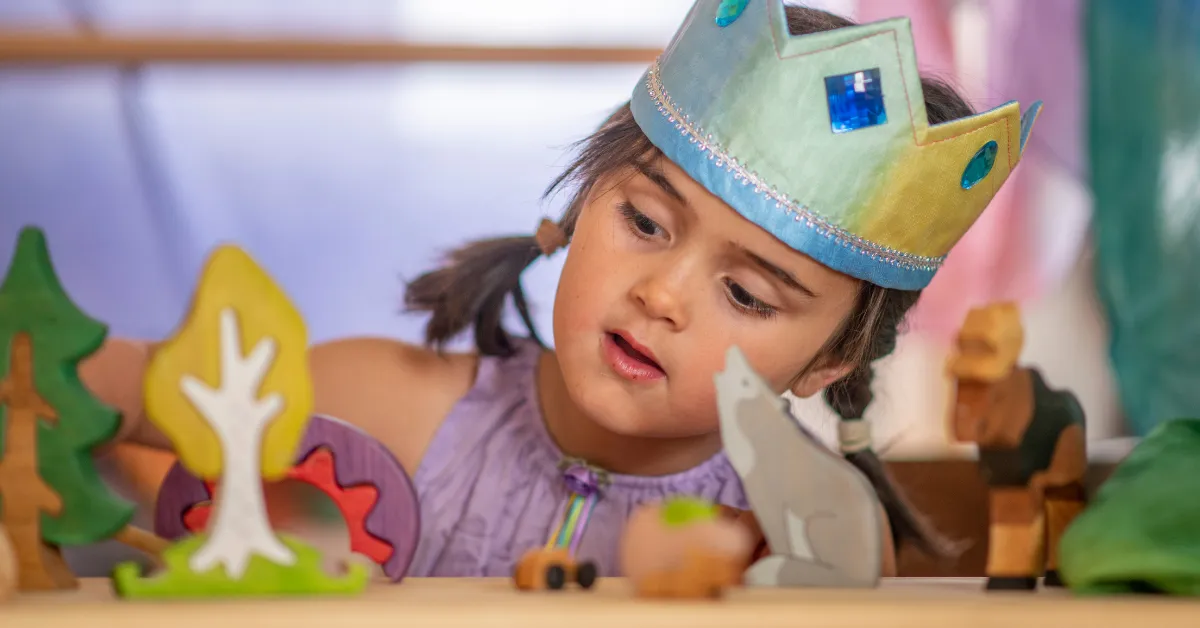
Free play is play that children start themselves and decide for themselves how it unfolds. Adults stay nearby and keep an eye on safety, but they don’t join in. In this kind of play children build creativity, empathy and social skills.
Free play can take many forms. A lot depends on how many children take part. Below we describe three main kinds of free play and what each one gives children.
1. Playing alone: the inventor’s workshop
A child plays alone with blocks, dolls or cardboard boxes. They build worlds, make up stories and act out different characters.
- What it develops: creativity, focus, independence, handling emotions.
- Why it matters: the child learns to create on their own terms and to draw on their own imagination.
2. Playing in pairs: a dance for two
Two children build a den, act out roles and make up rules. There is laughter, bargaining, the odd argument and making up again.
- What it develops: empathy, cooperation, flexibility, close friendships.
- Why it matters: children learn to create something together, a bit like musicians improvising a piece.
3. Playing in a group: a small society
Three or more children form a crew, share out roles and invent more complex games with rules and missions.
- What it develops: leadership, teamwork, resolving conflicts.
- Why it matters: group play is harder. In it, children learn to be part of a community.
Which kind is most common?
- Alone: most often in younger children (ages 2–4).
- In pairs: appears along with first friendships.
- In a group: less common, because it takes more maturity and more chances to meet.
It’s good for a child to experience all three. The last one disappears most easily. Group play needs several children, free time and a place to meet, and today those three things rarely come together on the same afternoon.