
In [month] [year] we visited Zielona Huśtawka preschool to talk with parents about free play. This is play that children start themselves, with no script and no adults setting the rules. Adults stay nearby and keep an eye on safety, but they don’t join in.
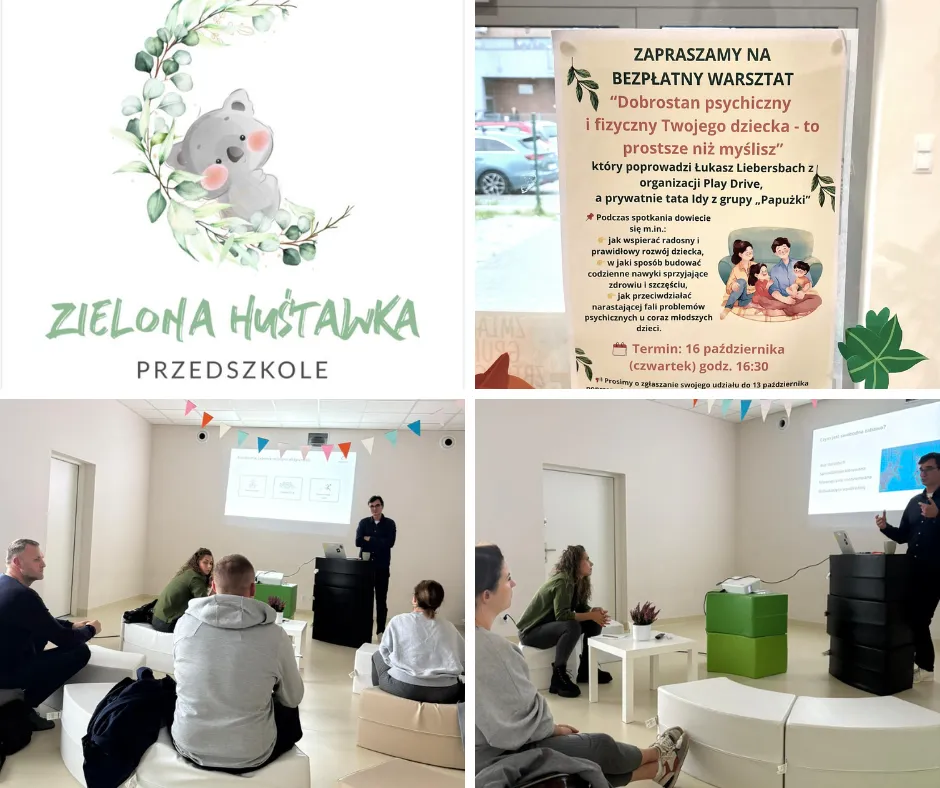
We started with a question:
“What childhood memory has stayed with you the most?”
Parents talked about climbing trees, running around outside with other kids, building dens and splashing through puddles. Most of these memories happened outdoors, with friends, often with no adults around.
From there we moved on to what children learn through play: coping with difficulties, getting along with others, taking small risks and setting their own boundaries.
Where has play gone?
Together we asked why children play less freely today. Parents mentioned:
- a lot of screen time
- a lack of safe, open spaces
- busy family schedules
- less contact and trust between neighbours
Some noticed that as adults we ourselves set an example of caution and keeping to ourselves. One person said:
“Maybe part of the problem is that we adults don’t seek out other people the way we used to. Children just watch us.”
From then on we also talked about ourselves and what our everyday lives look like.
Play and mental health
Many people were worried about their children’s mental health. Parents talked about long waiting lists for child psychologists, growing anxiety and trouble with relationships.
We showed results from a large survey of child psychologists, in which social isolation was named as one of the main causes of the current crisis. Nobody was surprised. We can all see how few chances there are today for spontaneous meetings and play with other children.
Free play gives children a chance to let off steam, move, spend time together and feel part of a group.
Ideas and small steps
Parents also came up with practical solutions. The favourite was a “playground childcare swap”. A few parents who are friends agree that one of them looks after a small group of children while the others get some time off. Next time they swap. Children meet more often, and parents share the load.
We also talked with the preschool about a Free Play Club: a regular weekly slot when children play spontaneously and adults only look after safety.
Questions to take home
The meeting ran much longer than we had planned. Thank you to all the parents who came and shared their thoughts. At the end we left them with three questions to think about:
- What were your favourite games as a child?
- What gets in the way of your child’s free play today?
- What one small thing could you do to help your child play more, and more freely?