
Patagonia is a clothing brand known around the world for its care for the environment. It runs Worn Wear, a programme that gives its clothes a second life, and has run campaigns encouraging people to boycott Black Friday.
Less well known is that Patagonia is also a strong supporter of free play. It runs a preschool for its employees’ children, where free play outdoors is the backbone of the day.
A day at Patagonia’s preschool
Patagonia describes its approach in an article on its website. Play there starts with exploration. Teachers look for potential in simple objects. The company has a sewing room, a design studio, a café and a shop, and these supply the preschool with fabric scraps, cardboard boxes and long tubes. According to Patagonia, children play best when they make toys themselves from whatever they find, rather than being handed ready-made, branded ones.
Children climb trees, hunt for insects and pretend to fly to the Moon. Babies discover their own hands and feet, and toddlers look under every stone. The preschool tries to keep children curious about the world and eager for challenges for as long as possible.
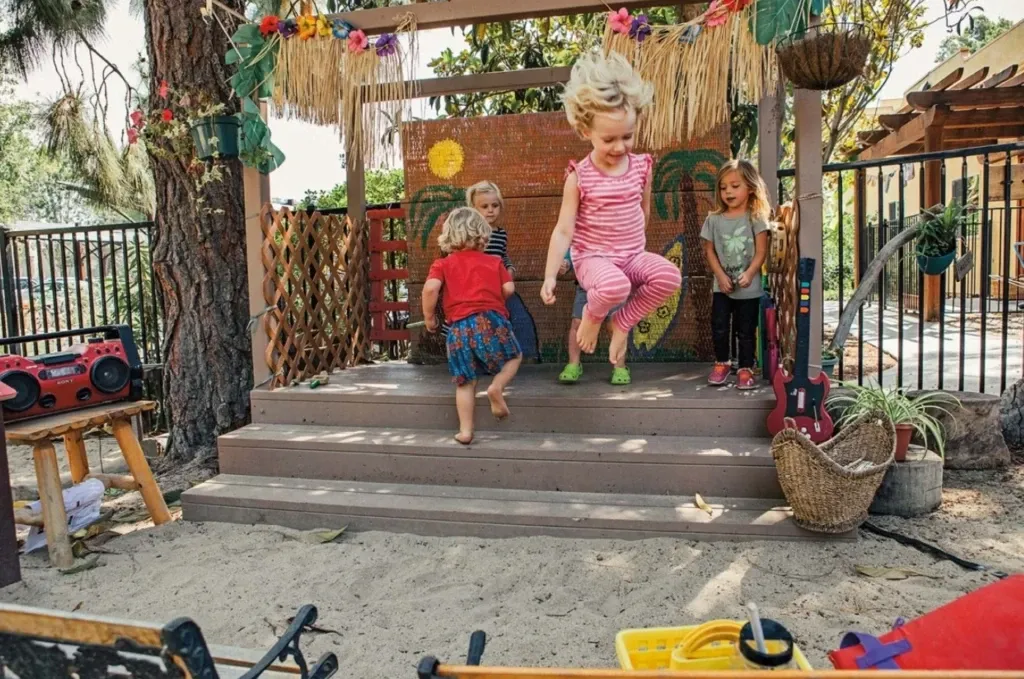
Patagonia’s preschool
Play can be hard
Patagonia points out that play is far from easy. Every child wants things to go their way, and what they have imagined often turns out to be impossible. Sometimes frustration pushes children to look for solutions, and sometimes it’s too much. Teachers watch the children and know when to help just a little, so that the children still reach their goals themselves.
Staff also notice that when a game goes exactly by the rules, children quickly get bored. In play, what counts is the play itself, not reaching the finish line fast. The preschool draws on the adventure playground movement, where children get tools and all kinds of building materials so they can carry out their own ideas.
What others can take from this
Few companies will run their own preschool. But any preschool can do what Patagonia does: give children simple materials, plenty of time outdoors and teachers who help only when needed.
You can read Patagonia’s full article here.