
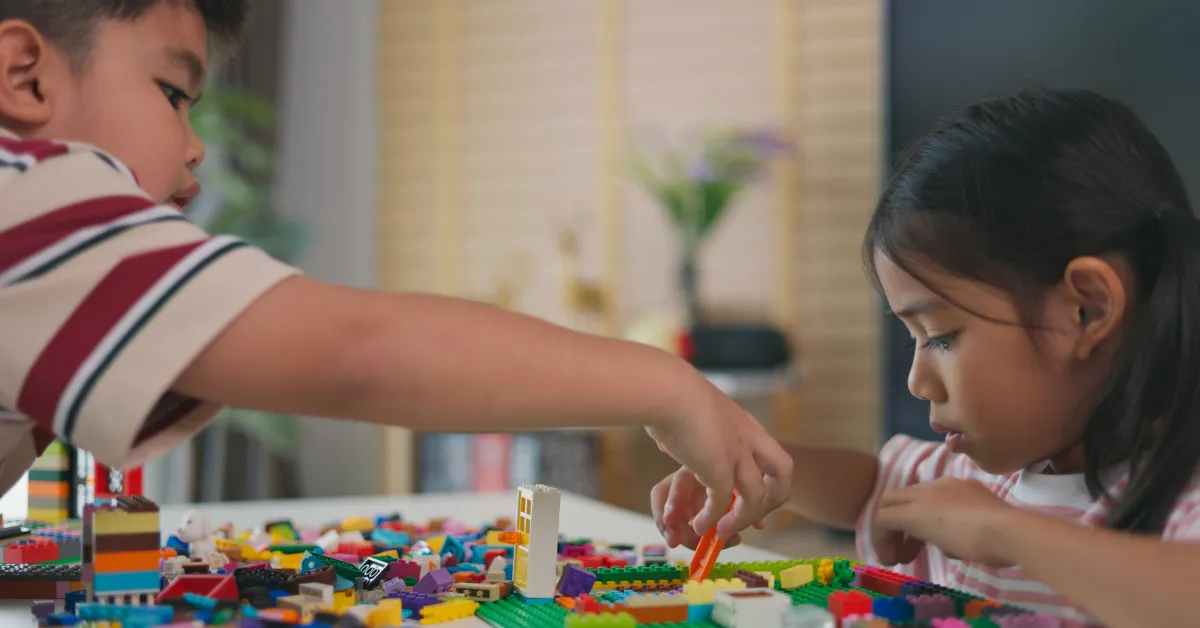
Imagine your child in a sandpit. They build a tower, knock it down, fix it and build it again. Nobody gave them instructions or a goal. They’re acting out of curiosity. This is what free play looks like: the child starts it, decides what happens next and doesn’t know in advance how it will end. In this kind of play children practise the skills they need for creative, innovative thinking.
How free play teaches innovation
Four mechanisms link free play to innovative thinking. They match the skills that companies call creative thinking, adaptability, collaboration and problem-solving.
1. Imagination and trial and error
In free play children invent worlds, rules and roles. They try, get things wrong and try again. Research shows that time for free play supports creative thinking. In business it looks similar: a startup tests a product, sees that customers don’t want it, and changes direction. From an early age, free play builds the readiness to try something, see what works, throw it out and try again.
2. Independent thinking and agency
When a child decides what to play and how, they choose the problem and come up with the solution themselves. The feeling of “I decide what happens next” is needed for independent thinking. Someone who spent their whole childhood mostly following instructions is less likely to ask later: “What if…?”
3. Collaboration and resolving conflicts
Free play often happens in a group. Children negotiate rules, argue, split into teams and change line-ups. One study calls this “collective creativity”: during play the group invents new rules on its own and then develops the best idea. At work, too, people rarely work alone. They have to persuade others, compromise, listen and change direction together.
4. Flexibility and coping with uncertainty
Free play has no script and no test at the end. Children learn to cope with an unclear situation: “We don’t know what we’re playing yet, let’s make it up together.” Research shows a strong link between free play and executive functions: children who play freely more often are better at self-control, switch their attention more easily and control their impulses. Innovation is uncertain too. People who can adapt, change direction and pick themselves up after a failure cope with it better.
Why this matters today
Innovation today rarely comes from a lone genius. It comes from teams that test ideas quickly, gather feedback and improve the product. Companies increasingly work in small steps: they build a simple version of a product, see how it works and change it. Children in a sandpit do the same.
Meanwhile, many children’s days are filled with organised activities, lessons and screens. There is little time left in which they can come up with something and decide for themselves. Parents can keep a few afternoons a week free for their child. Schools can give children more time at break and for open-ended projects. Companies looking for creative employees can support local initiatives that give children back their time to play.